Koi Hobbyist Visit 2026 Mr. Eiji Kadowaki (Hokkaido)
The Satisfaction of Designing and Building It Yourself
A Cut-Above, “Pro-Spec” Liner Pond
When hobbyists set out to build a concrete pond, cost is usually the first concern. But once you also consider how long construction takes and what happens if the pond ever has to be demolished, cost is far from the only hurdle. That is where liner ponds come in as a strong alternative. Over the years, this magazine has featured many liner ponds, from simple designs to full-scale ponds that could easily be mistaken for concrete.
Compared with past examples, Mr. Kadowaki’s liner pond is very much the “real deal.” In Hokkaido a pond house is essential, so construction costs were of course a consideration, but for Mr. Kadowaki the bigger factors seem to have been the speed of construction and his confidence that a liner could deliver more than enough quality. The materials he uses are a grade above those typically used for ponds. Relaxing in the bright pond house while gazing at his koi is, for Mr. Kadowaki, a time of healing like no other.
The Ultimate Liner, Chosen by a Building-Materials Pro
A Timber Frame, Treated Against Rot and Thoroughly Reinforced
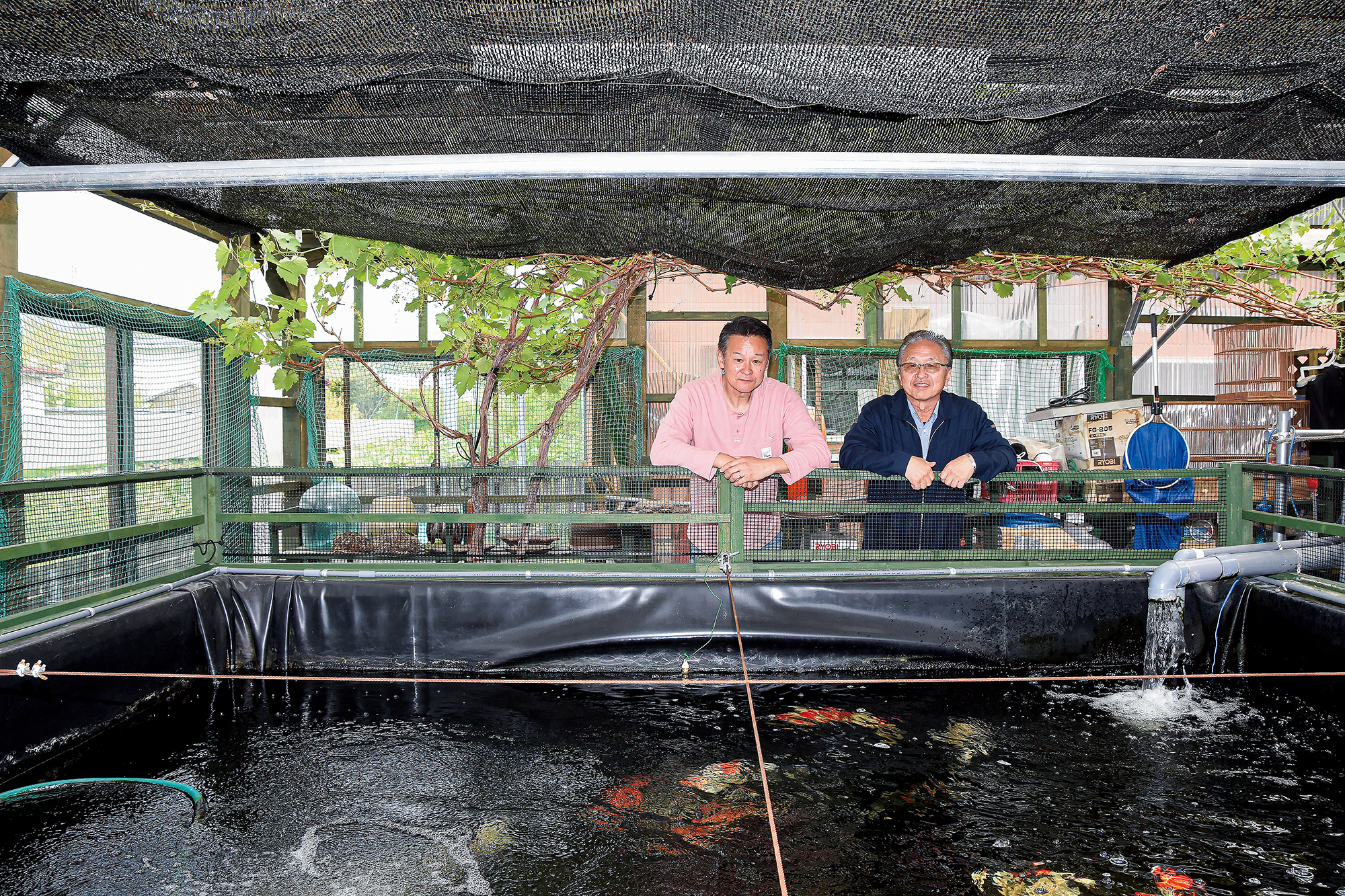
The scent of wood fills the pond house. Overhead, grapevines spread out, and their fresh young leaves glow vividly as sunlight passes through them. The pond house has been extended several times over the years, and its basic frame is now more than 20 years old. It is entirely handmade from reclaimed timber. A great many beams run along the walls and ceiling, and the thick central beam gives a strong impression of sturdiness. Because the wood is coated with a high-quality preservative, damage from condensation and the like is kept to a minimum.
Mr. Kadowaki runs a company that handles a wide range of building materials, so he is in an ideal position to source everything needed for pond building. As a result, the ponds and the pond house are mostly handmade. By using the right material in the right place, he has achieved a level of finish that overturns the image of liner ponds as makeshift ponds.
Inside the pond house, finished throughout in green—his favorite color—there are two ponds: one of about 6.5 tons and one of about 14 tons, nearly twice the size. The 6.5-ton pond measures 2.4 m × 2.7 m and is about 1 m deep, with roughly 30 cm of that below ground. It used to be 60–70 cm deep, but a few weeks before our visit he raised its walls so that it can also accommodate large koi.
The 14-ton pond is a 3.6 m square with a water depth of 1.1 m. Here too, the bottom 30–40 cm is below ground. Compared with the free-standing designs common among liner ponds, the biggest advantage is probably the greater stability of the pond itself, including better distribution of water pressure. It takes more earthwork, but it gives far more peace of mind than relying on the side walls alone to hold back the water. In the Hidaka region, where earthquakes are frequent, it is also an effective way to protect the pond from damage caused by shaking.
Another notable structural feature is that no steel pipes are used. Liner ponds are often built with a frame of scaffolding pipes and plywood panels, but to avoid rust—the weak point of metal—Mr. Kadowaki chose timber. His conclusion as a building-materials specialist was that sufficient strength can be achieved by reinforcing the frame with screws, corner brackets and the like. As extra support, heavy-duty civil engineering wire rope of the kind used to hoist loads of several tens of tons is stretched crosswise over the top of each pond, and steel stakes are driven into the ground at the base of the side walls to stop them spreading under water pressure. Thanks to these thorough measures, he says he has been able to enjoy keeping koi without any trouble.