The Zen Nippon Airinkai Lecture Meeting
JPD Fish Disease Seminar
Countermeasures for “Hi-kui Disease,” “Sinking Syndrome,” and “Dropsy (Pinecone Disease)”
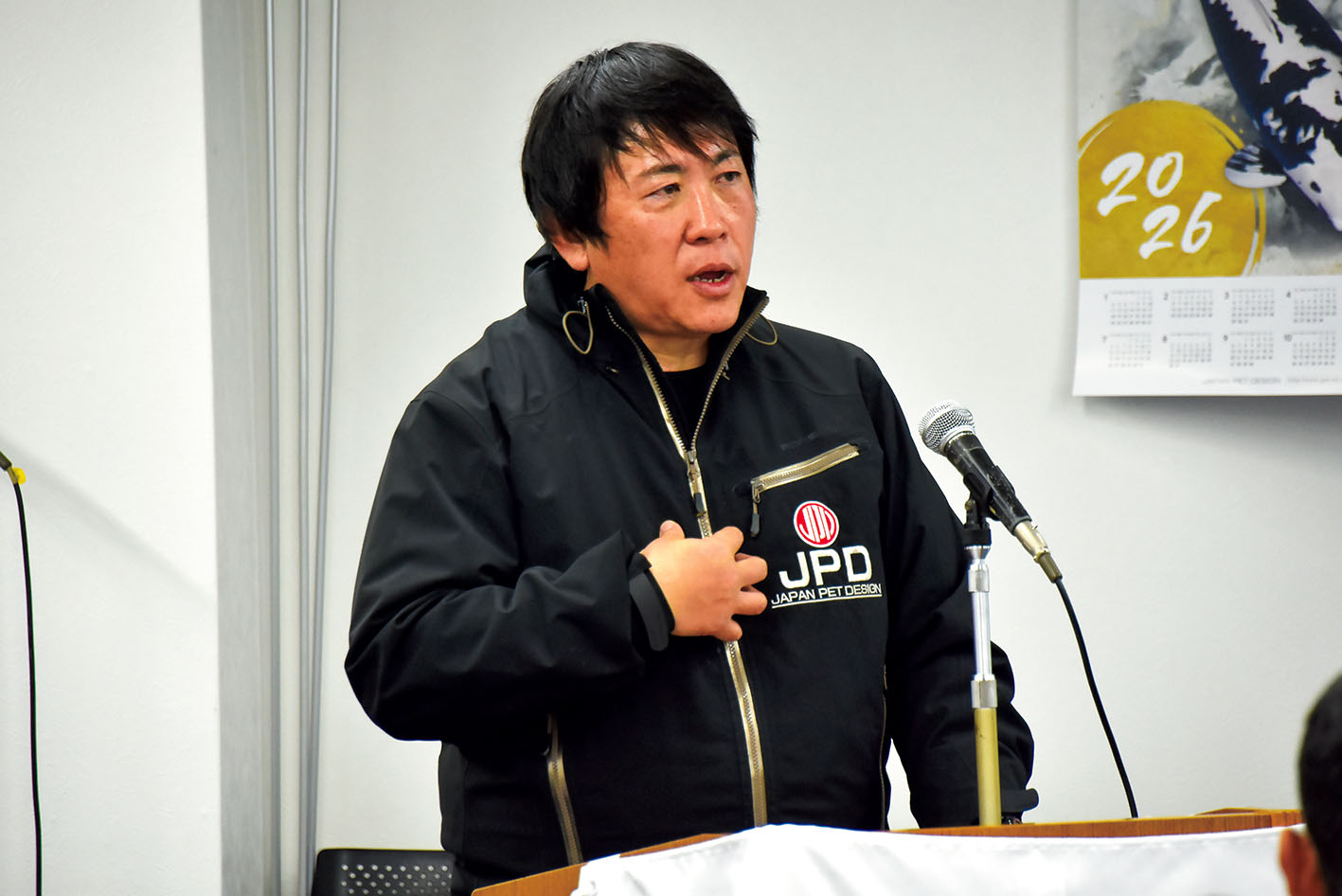
Our company was originally founded in 1819 in Katsushika Ward, Tokyo, where we bred goldfish and koi. Later, in 1969, we established Japan Pet Design Co., Ltd. (JPD) and began selling fish disease treatments.
When people hear “JPD,” they often think of it purely as a pharmaceutical company. However, about 60 years ago, my uncle’s company, Yoshida Feed, developed a floating koi feed called “Swimmy.”
After my uncle passed away, the name “Yoshida Feed” was removed from the packaging.
Feeling a strong responsibility to carry on the family business, we began producing and selling koi feed under Japan Pet Design Co., Ltd. as well.
As a pharmaceutical manufacturer, our company has advanced its research and development through collaborative studies with Professor Miyazaki of Mie University and Associate Professor Yasumoto of the National Fisheries University.
When it comes to koi feed, our top priority is health. Having been involved with Nishikigoi for over 30 years, I have seen many hobbyists—both in Japan and abroad—start keeping koi, only to give it up. The primary reason for this is the disease. In many cases, people quit the hobby after losing their koi to illness.
Motivated by the goal of protecting koi from disease, even in small ways, we have held seminars on fish health both domestically and internationally. To date, we have visited approximately 30 countries, with 495 visits to overseas breeders and dealers, and 624 visits within Japan. As these figures are from five years ago, the current numbers have since exceeded them. Thanks to this, our feed is now used by many breeders, distributors, and hobbyists.
The development and testing of our feed and medicines are conducted not only in research institutions, but also in real-world environments, including hobbyists’ garden ponds and breeding sites, with the cooperation of many people.
By visiting sites in person, we have gained valuable insights into which products are needed and how our existing products should be improved, and we have addressed these matters with sincerity.
Therefore, whether it is one of our sales representatives or me, we would greatly appreciate hearing your feedback, such as any challenges you are facing or products you would find helpful. We value your input and would like to incorporate your suggestions into our future product development.
Today, as part of this seminar on fish diseases, I would like to talk about “Hi-kui Disease,” “Sinking Syndrome,” and “Dropsy (Pinecone Disease)”.
First, what is Hi-kui Disease? Hi-kui Disease is a condition in which the red pigment cells in the hi (red pattern) area undergo changes, forming tumour-like lesions. It is considered a skin disease; however, it is also extremely difficult to cure completely.
However, if detected early, it is possible to stop the progression of the disease, and particularly in younger koi, there is a relatively high chance that the hi (red pattern) will recover. It has also been observed that some koi are more prone to developing Hi-kui Disease than others.
The causes of Hi-kui Disease are generally thought to fall into two main categories. The first is sunlight. It tends to occur in environments where koi are exposed to strong sunlight throughout the day, and particular caution is required in regions with intense sun exposure, such as Southeast Asia. If koi are kept for long periods under the blazing summer sun without any roof or shade, the red pigment cells can suffer excessive damage, making them more prone to developing Hi-kui Disease.
This is similar to how human skin becomes red or inflamed from sunburn—koi are also strongly affected when their red pigment cells are exposed to sunlight. Therefore, especially during periods of intense summer sun, it is important to provide shaded areas where the koi can take refuge.
Another factor is the excessive use of colour-enhancing feed.
Overfeeding this type of feed puts stress on red pigment cells, making them more prone to abnormalities. This is similar to human skin—just as overeating or excessive drinking can lead to skin problems or dullness; it can also have a negative impact on Nishikigoi.
Therefore, by providing appropriate shading in the pond and avoiding overfeeding colour-enhancing feed, we believe that sufficient preventive measures against Hi-kui Disease can be achieved.
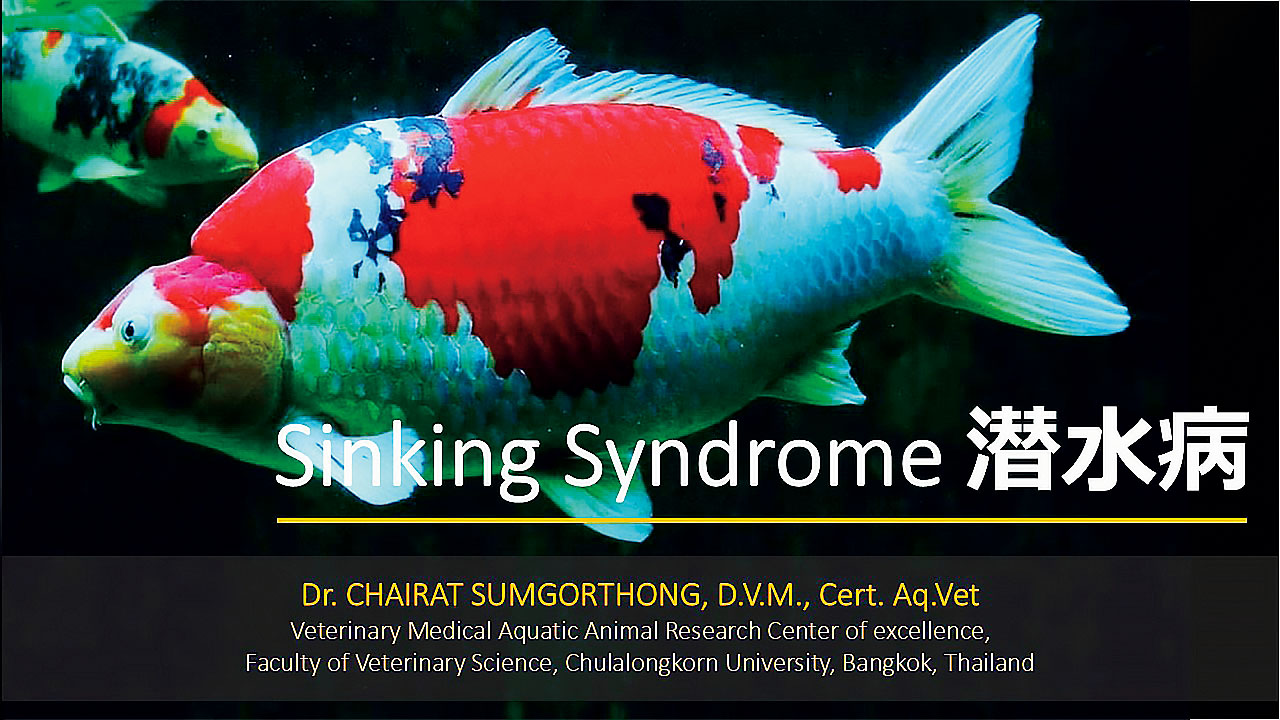
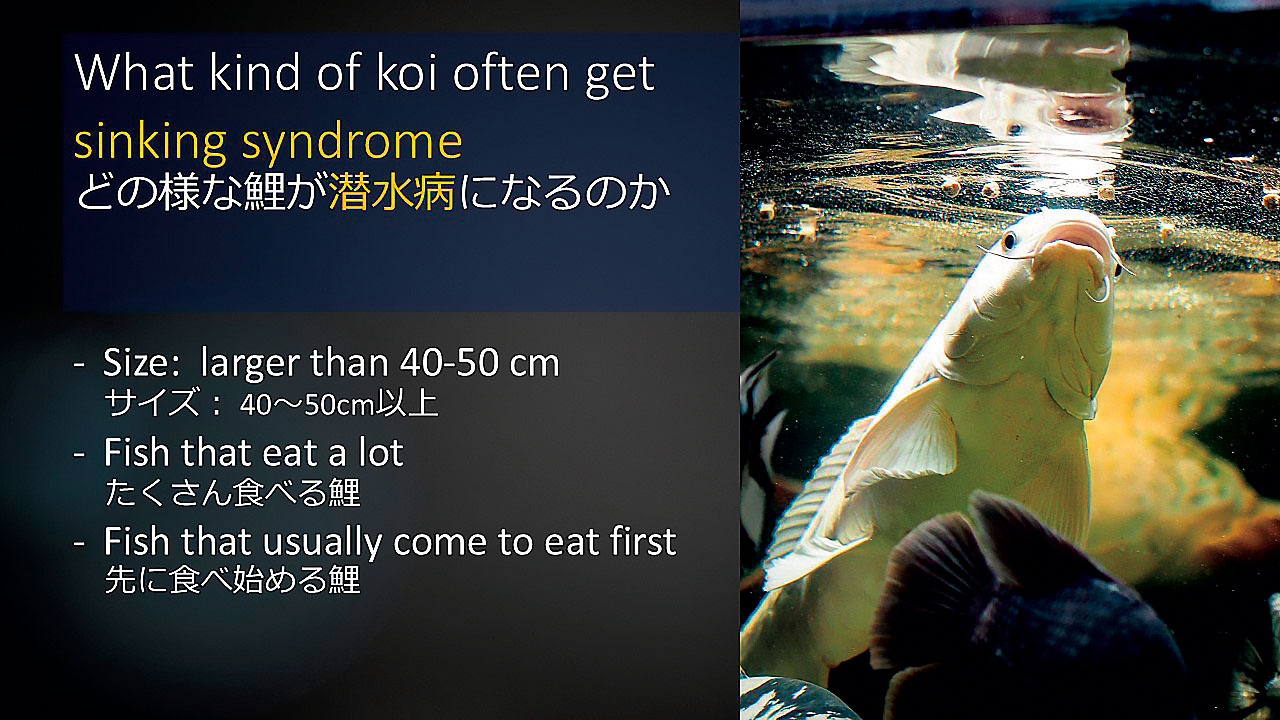
Next, I would like to discuss Sinking Syndrome. It is understood that this condition is caused by the swim bladder becoming compressed within the body. Typical symptoms include repeated vertical swimming movements, and eventually the koi will remain at the bottom, struggling and fluttering its fins. It most commonly occurs in koi aged 4 or older, and is rarely seen in younger koi measuring around 30 cm.
When koi that have become completely immobile due to Sinking Syndrome are examined to identify the causative agents, fungi, parasites, and bacteria are often detected. In some cases, examination of deceased koi reveals a condition in which they are infected with almost all types of pathogens, so to speak, like an “all-star lineup” of pathogens.
However, this did not reveal the true cause, so we examined around 30 koi in the early stages of the condition. What they had in common was that their swim bladders were compressed and filled with fluid. In other words, Sinking Syndrome is a condition caused by a disorder of the swim bladder.
There are several patterns in which fluid can accumulate in the swim bladder.
The first is the overfeeding of floating feed. In koi, the mouth is structurally connected to the swim bladder. In the past, feeding was typically done about twice a day, but in recent years the frequency has increased to six, twelve, or even twenty-four times a day. When feeding is too frequent, and koi consume excessive amounts of floating feed, they end up swallowing small amounts of water with each bite.
If this continues twelve times a day, 365 days a year, small amounts of water gradually accumulate, eventually leading to the early stages of Sinking Syndrome. In fact, when koi showing early symptoms are dissected, and their swim bladders are examined, no bacteria are found in some cases—only clear fluid is present.
In such cases, inserting a long needle from outside the body to remove the fluid and replace it with air may allow the koi to swim again. However, in koi that develop Sinking Syndrome due to ingesting water, this tendency often becomes habitual, and the condition is likely to recur.
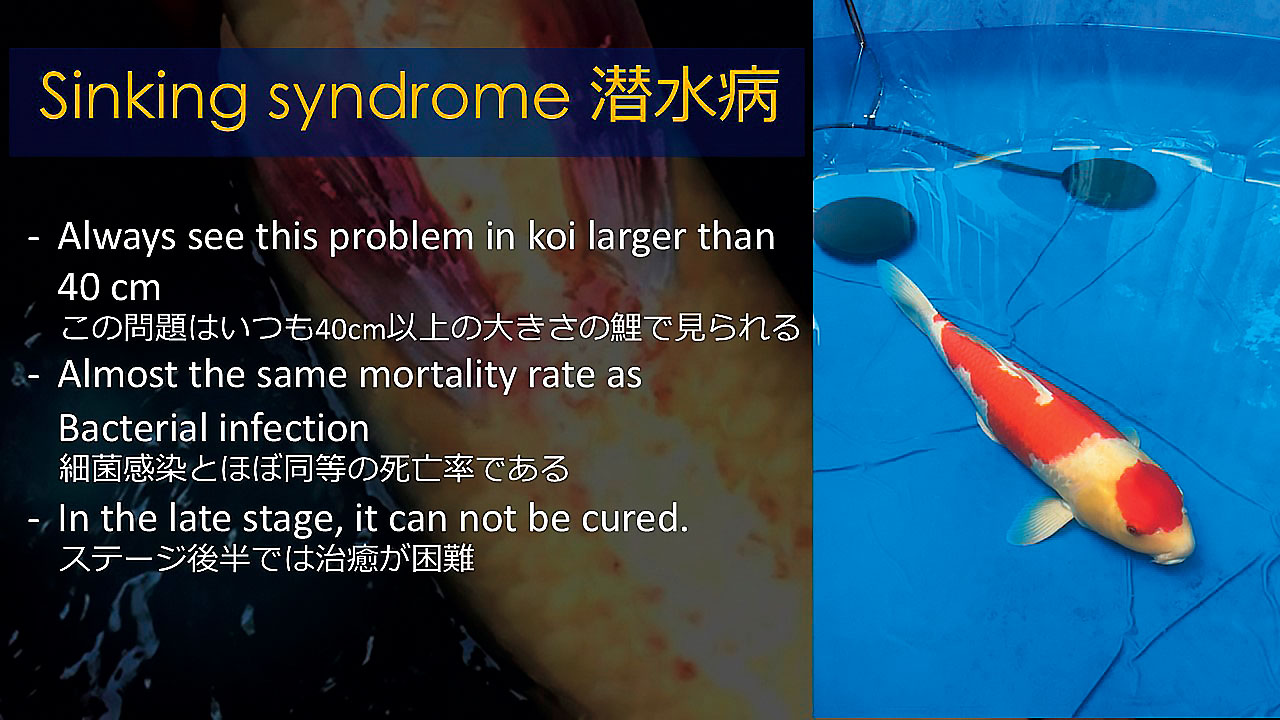
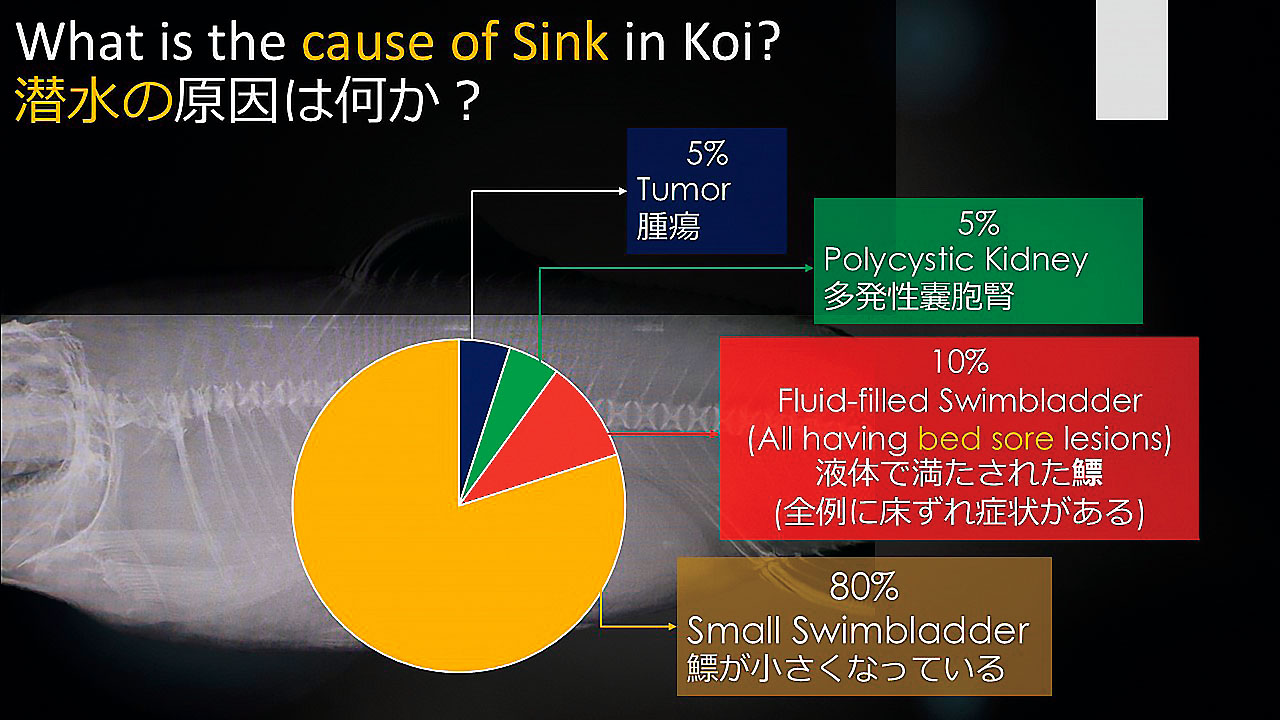
The second pattern involves disorders of internal organs. When overfeeding persists, it strains the body and weakens the koi’s condition, making it easier for bacteria to enter the body. In such cases, administering antibiotics may lead to recovery as the internal condition improves, and based on experience, improvement is seen in approximately 30% of cases.
Additionally, Sinking Syndrome can also occur when excessive feeding causes gas to accumulate in the body, and this gas compresses the swim bladder. When the swim bladder is compressed, the koi cannot swim freely, and as an early symptom, they are often seen trying to swim by frequently moving their fins.
Another possible cause is intestinal impaction. This condition is mainly seen in female koi, and when they are kept in concrete ponds, they may be unable to fully reabsorb or process the eggs within their bodies. If this occurs repeatedly, residual egg material can remain inside the body, and in severe cases, dissection reveals stone-like masses that, when cut open, show layered structures resembling tree rings.
As these masses grow larger, they compress the swim bladder, making it difficult for the koi to swim.
Therefore, we believe that allowing koi to spawn at an appropriate time can help prevent intestinal impaction and maintain proper body shape.
In this way, Sinking Syndrome can develop; however, as a preventive measure or countermeasure, we believe that feeding sinking-type feed can be effective.
Koi have downward-facing mouths and are naturally bottom feeders that consume food from the pond floor.
In fact, there have been cases where koi affected by Sinking Syndrome recovered after being released into mud ponds. Rather than relying solely on floating feed, we believe that occasionally providing sinking feed can also be an effective countermeasure.